Entries for January 2025

-
-
Monetize AI, not the editor
A certain characteristic of legacy desktop apps, like Microsoft Office, Autodesk AutoCAD, Adobe Photoshop and so on, are that they have crappy proprietary file formats. In 2025, we barely have reliable, fully-supported open source libraries to read and write .DOCX, .XLSX, .PPTX,1 .DWG, .PSD and so on, even though related products keep making billions in revenue.
The reason is simple: Moat through obfuscation.
The business model for these products when they first appeared in the 1980s and 1990s was to sell the compiled binaries for a one-time fee. This was pre-internet, before Software-as-a-Service (SaaS) could provide a reliable revenue stream. Having a standardized file format would have meant giving competitors a chance to develop a superior product and take over the market. So they went the other way and made sure their file formats would only be read by their own products, for example by changing the specifications in each new version. To keep their businesses safe, they prevented interoperability of entire modalities of human work, and by doing so, they harmed the entire world’s economy for decades.2
Can you blame them? The only thing they could monetize was the editor. Office 365 and Adobe Creative Cloud has since implemented a SaaS model to capitalize even more, but the file formats are still crap—a vestige of the old business model.3
But finally, a revolution is underway. This might all change.
None of these products were designed to be used by developers. They were designed to be used by the “End User”. According to Microsoft, the End User does not care about elegance or consistency in design.4 The End User could never understand version control. The End User sends emails back and forth with extensions such as
v1.final.docx,v1.final.final.docx. Until recently, the End User was the main customer of software.However, we have a new customer in the market: AI. The average AI model is very different than Microsoft’s stereotypical End User. They can code. In fact, models have to code, or at least encode structured data like a function call JSON, in order to have agency. Yes, we will also have AIs using computers directly like OpenAI’s Operator, but it is generally more straightforward to use an API for an AI model than to use an emulated desktop.
We will soon witness AI models surpass the human End User in terms of economic production. Tyler Cowen5, Andrej Karpathy6 and others are convinced that we should plan for a future where AIs are major economic actors.
“The models, they just want to learn”. The models also want intuitive APIs and simple file formats. The models abhor unnecessary complexity. If you have developed a RAG pipeline for Excel files, you know what I mean.
If AI creates pressure to replace legacy file formats, then what can companies monetize if not the editor? The answer is the AI itself. Serve a proprietary model, serve an open source model, charge per tokens, charge for inference, charge for kilowatt-hours, charge for agent-hours/days. The business model will differ from industry to industry, but the trend is clear: value will be more and more linked to AI compute, and less and less to Software 1.07.
There is now a huge opportunity in the market to create better software, that follow the File over App philosophy:
if you want to create digital artifacts that last, they must be files you can control, in formats that are easy to retrieve and read. Use tools that give you this freedom.
We already observe that AI systems work drastically more efficiently if they are granted such freedom. There is a reason why OpenAI based ChatGPT’s Code Interpreter on Python and not on Visual Basic, or why it chose to render equations using LaTeX instead of Office Math Markup Language (OMML)8. Open and widespread formats are more represented in the datasets, and the models can output them more correctly.
There is going to be an AI-native “Microsoft Office”, and it will not be created by Microsoft. Copilot is not it, and Microsoft knows it. Boiling tar won’t turn it into sugar. Same for other Adobe, Autodesk and other creators of clutter.
Internet Explorer’s 2009 YouTube moment is coming for legacy desktop apps, and it will be glorious.
-
Yes, Microsoft’s newer Office formats .DOCX, .XLSX, .PPTX are built on OOXML (Office Open XML), an ISO standard. But can all of these formats be rendered by open source libraries exactly as they appear in Microsoft Office, in an efficient way? Can I use anything other than Microsoft Office to convert these into PDF, with 100% guarantee that the formatting will be preserved? The answer is no, there will still be inconsistencies here and there. This was intentional. A moment of silence for the poor souls in late 2000s Google who were tasked with rendering Office files in Gmail and Google Docs. ↩
-
For a recent example of how monopolies create inferior products, imagine the efficiency increase and surprise when Apple Silicon (M1) first came out, and how ARM is now the norm for all new laptops. We could have had such efficiency a decade before, if not for Intel. ↩
-
On the other end of the spectrum, we have companies that are valued in the billions, despite using standardized open source standards: MongoDB uses Binary JSON (BSON), Elasticsearch uses JSON, Wordpress (Automattic) uses MySQL/PHP/HTML,CSS, and so on. ↩
-
Companies like Notion beg to differ: Software should be beautiful. People apparently have a pocket for beauty. ↩
-
Traditional pre-AI software, as opposed to Software 2.0. ↩
-
Long forgotten format for Microsoft Equation Editor. ↩
-
-
Calling strangers uncle and auntie
Cultures can be categorized across many axes, and one of them is whether you can call an older male stranger uncle or female stranger auntie. For example, calling a shopkeeper uncle might be sympathetic in Singapore, whereas doing the same in Germany (Onkel) might get a negative reaction: “I’m not your uncle”.
This is similar to calling a stranger bro. In social science, this is called fictive kinship, social ties that are not based on blood relations. For readers which come from such cultures, this does not need an explanation. But for other readers, this might be a weird concept. Why would you call a stranger uncle or auntie?
Hover over the countries below to see which ones use uncle/auntie terms:
Countries that use uncle/auntie terms as fictive kinship.
If you notice any errors, you can submit a pull request on the repo osolmaz/crowdsource.Note that fictive kinship can also have different levels:
-
Level 0: Blood relatives only. “Uncle”/”Auntie” is strictly for real uncles/aunts (by blood or marriage). No fictive use.
-
Level 1: Close non-relatives. Used for family friends, “uncle” or “auntie” is an honorary title but not for random people.
-
Level 2: Casual acquaintances. Used more widely for neighbors, family friends, or community members you vaguely know, but typically not for an absolute stranger.
-
Level 3: Total strangers. Used even for someone you’ve just met: a shopkeeper, taxi driver, or older passerby.
Many cultures fall somewhere between these levels and it’s not always black and white. Where possible, I’ve simplified it to the most typical usage.
Ommerism and social cohesion
The thought first occurred to me when I visited Singapore and heard people use uncle and auntie. Here were people speaking English, but it felt like they were speaking Turkish (my mother tongue).
The cultural difference is apparent to me as well since I started living in Germany. People here are more lonely, strangers distrust each other more, and there are no implicit social ties. I guess this holds for the entire Anglo/Germanic culture, including the US and the commonwealth.
Don’t get me wrong, people in Turkey distrust each other as well, probably even more. It is a more dangerous country than Germany. But those dangerous strangers are still uncles. It’s weird, I know.
As far as I could tell, the phenomenon is not even sociologically that much recognized or studied. There is no specific name for it, other than being a specific form of fictive kinship. Therefore, I will name it myself: ommerism. It derives from a recently popularized gender-neutral term for an uncle or auntie, ommer.
Lack of ommerism is an indicator for a weak collective culture. Such cultures are more individualistic, familial ties are weaker and people are overall more lonely. People from such cultures could for example tweet:
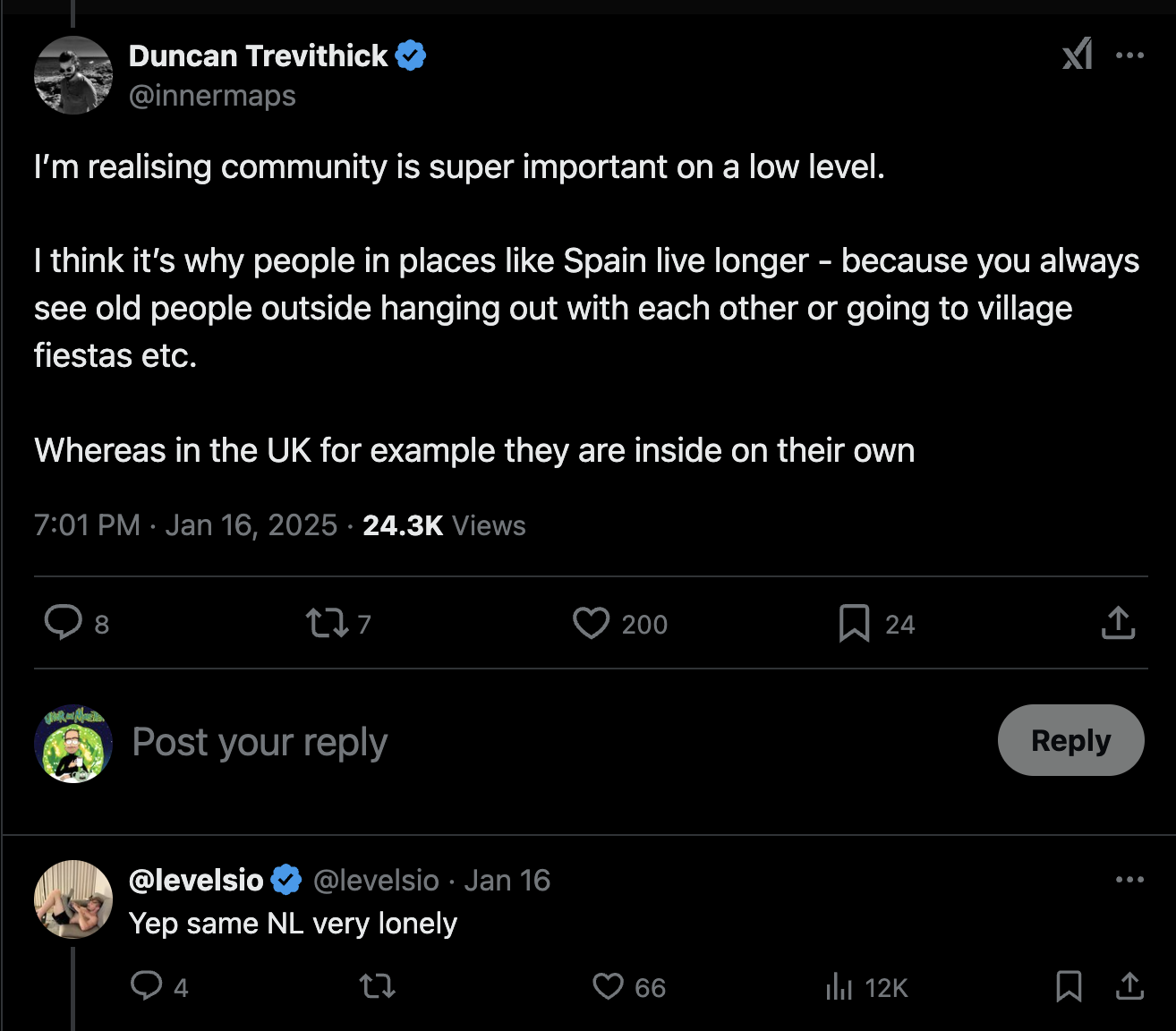
It is extra ironic that ex-colonies like Singapore (ex-British), Indonesia (ex-Dutch), Philippines (ex-Spanish) etc. took their colonizers’ words for uncle/auntie and started using it this way, whereas the original cultures still do not.
Related articles
Click to expand more detailed notes on ommerism in different cultures, generated by o1:
East Asia
China (Mainland China, Hong Kong, Taiwan)
- Mandarin Chinese: Older men can be called 叔叔 (shūshu) or 大叔 (dàshū), and older women 阿姨 (āyí)—literally “uncle” and “aunt.”
- Cantonese: Common terms include 叔叔 (suk1 suk1) and 阿姨 (aa4 yi4).
- These terms are used with neighbors, parents’ friends, or sometimes older strangers as a sign of respect.
South Korea
- While there is no exact one-word translation for “uncle” or “aunt” used for strangers, 아저씨 (ajeossi) for an older male and 아줌마 (ajumma) for an older female are frequently used.
- In more affectionate or polite contexts (like someone only slightly older, perhaps a friend’s older sibling), you might hear 삼촌 (samchon, literally “uncle”) or 이모 (imo, literally “maternal aunt”) in certain familial or friendly settings. However, ajeossi and ajumma are the most common for strangers.
Japan
- おじさん (ojisan) means “uncle” (or older man), and おばさん (obasan) means “aunt” (or older woman).
- These words are often used for middle-aged adults who aren’t close relatives. However, obasan and ojisan can sometimes sound a bit casual or even rude if the person thinks they’re not that old—so usage requires some caution.
Mongolia
- Familial terms for older people exist (e.g., avga for “aunt,” avga ah for “uncle”), though usage for complete strangers varies by region or family practice. The practice is somewhat less formalized than in, say, Chinese or Korean, but it does occur in more traditional or rural settings.
Southeast Asia
Vietnam
- Common terms include chú for a slightly older man (literally “uncle”), bác for an older man or woman (technically also “uncle/aunt” but older than one’s parents), and cô or dì for an older woman (“aunt”).
- These terms are commonly used even for unrelated people in the neighborhood or community.
Thailand
- Thais typically use kinship or age-related pronouns. ป้า (pâa) means “aunt” and is used for women noticeably older than the speaker; ลุง (lung) means “uncle” for older men.
- พี่ (phîi) (“older sibling”) is also used for someone slightly older, but not as old as a parental figure.
Cambodia (Khmer)
- Kinship terms like បង (bong) (“older brother/sister”) are used for somewhat older people, but for someone older than one’s parents, ពូ (pu) (“uncle”) or មីង (ming) (“aunt”) are common.
Laos
- Similar to Thai and Khmer, Laotians use ai (“uncle”) and na (“aunt” in some contexts), though often you’ll see sibling terms like ai noy as well.
Myanmar (Burma)
- Burmese uses kinship terms such as ဦး (u) for older men (sometimes “uncle”) and ဒေါ် (daw) for older women (sometimes “aunt”). Strictly, u and daw are more like “Mr.” / “Ms.” honorifics, but in colloquial usage, people also say ဘူ (bu) or နာ် (nà) for “uncle”/”aunt” in local dialects.
Malaysia & Brunei
- In Malay, pakcik (“uncle”) and makcik (“auntie”) are used for older men and women, especially in a neighborly or informal community context.
- Ethnic Chinese or Indian communities in Malaysia may use their own respective terms (Chinese “叔叔/阿姨,” Tamil “maama/maami,” etc.).
Indonesia
- Om (from Dutch/English “oom,” meaning “uncle”) and Tante (from Dutch “tante,” meaning “aunt”) are widely used for older strangers—especially in urban areas.
- In Javanese or other local languages, there are also variations for older siblings or parent-like figures.
The Philippines
- Using Tito (uncle) and Tita (aunt) for older strangers is very common, especially if they are friends of the family or neighbors.
- Filipinos also commonly address older peers as Kuya (“older brother”) or Ate (“older sister”) when the age gap is less.
Singapore
- Given Singapore’s multicultural society, people might say “Uncle”/”Aunty” in English, or the Chinese/Malay/Tamil equivalents. It is extremely common to address older taxi drivers, shopkeepers, or neighbors as “Uncle” or “Auntie” in everyday conversation.
Timor-Leste (East Timor)
- Influenced by Indonesian and local Austronesian customs, you’ll find use of Portuguese tio/tia (“uncle/aunt”) in some contexts, or local language equivalents for older strangers.
South Asia
India
- Uncle and Aunty (often spelled “Auntie”) are widely used in Indian English for neighbors, parents’ friends, or older people in the community.
- Regional languages have their own words: e.g., in Hindi, “चाचा (chacha)” / “चाची (chachi)” or “मामा (mama)” / “मामी (mami)”; in Tamil, “மாமா (maama)” / “மாமி (maami)”; etc. Usage varies by region.
Pakistan
- Similarly, “Uncle” and “Aunty” are used in Pakistani English. In Urdu or other local languages, you might hear “चाचा (chacha)” / “چچی (chachi)” or “ماما (mama)” / “مامی (mami)” depending on whether it’s paternal or maternal in origin—often extended to unrelated elders as a sign of respect.
Bangladesh
- In Bengali, “কাকা (kaka)” / “কাকি (kaki)” or “মামা (mama)” / “মামি (mami)” might be used similarly. Among English speakers, “Uncle/Aunty” is also common.
Sri Lanka
- Both the Sinhalese and Tamil-speaking communities (as well as English speakers) use “Uncle” and “Aunty.” Local terms exist as well, like “මාමා (mama)” in Sinhalese for a maternal uncle.
Nepal & Bhutan
- In Nepal, Hindi- or Nepali-influenced usage might include “Uncle/Aunty” in English or “kaka,” “fupu,” etc. in Nepali.
- In Bhutan, kinship terms in Dzongkha may be extended politely, and English “Uncle”/”Aunty” is sometimes heard too.
The Middle East
Arabic-Speaking Countries
(Countries such as Saudi Arabia, UAE, Oman, Yemen, Kuwait, Qatar, Bahrain, Jordan, Lebanon, Syria, Palestine, Iraq, Egypt, Morocco, Tunisia, Algeria, etc.)
- Common practice is to call an older male عمّو (ʿammo) (“uncle”) or خال (khāl, “maternal uncle”), and an older female عمّة (ʿamma) or خالة (khāla, “maternal aunt”). In more casual conversation, people might just say “ʿammo” or “khalto” (aunt) for a kindly older stranger.
Turkey
- Turks often use amca (“uncle”) for older men and teyze (“aunt”) for older women, even if unrelated. You might also hear hala (paternal aunt) or dayı (maternal uncle) in certain contexts, though amca and teyze are the most common “stranger but older” usage.
Iran (Persia)
- Persian speakers sometimes use عمو (amú) (“uncle”) for an older male and خاله (khâleh) or عمه (ammeh) for an older female, though it can be more common within a neighborhood or for family friends rather than complete strangers.
Israel
- Among Arabic-speaking Israelis, the same Arabic norms apply. In Hebrew, there is less of a tradition of calling older strangers “uncle/aunt,” though familial terms may sometimes be used in casual or affectionate contexts.
Africa
In many African countries, the concept of extended family and communal child-rearing leads to frequent use of “auntie” and “uncle” (in local languages or in English/French/Portuguese). A few notable examples:
Nigeria
- It’s extremely common, in both English usage and local languages (Yoruba, Igbo, Hausa, etc.), to call older strangers or family friends Uncle or Aunty as a sign of respect.
Ghana
- In Ghanaian English and local languages (Twi, Ga, Ewe, etc.), older neighbors or close friends of parents are called “Uncle” or “Auntie.”
Kenya, Uganda, Tanzania (Swahili-speaking regions)
- “Mjomba” (uncle) or “Shangazi” (aunt) might be heard, but more often you’ll hear people simply use English “Uncle/Auntie” in urban areas. Variations exist in tribal languages.
South Africa
- Among many ethnic groups (Zulu, Xhosa, etc.), as well as in colloquial South African English, calling an unrelated elder “Uncle/Auntie” is quite normal.
Other African Nations
- From Ethiopia and Eritrea (where you might hear “Aboye” or “Emaye,” though these are more parental) to francophone Africa (where “tonton” / “tata” in French can be used for older people), the practice is widespread.
The Caribbean
Many Caribbean cultures (influenced by African, Indian, and European heritage) commonly call elders “Auntie” and “Uncle”:
- Jamaica, Trinidad & Tobago, Barbados, Grenada, etc.: It’s very common in English Creole or local usage to refer to an older neighbor or friend as “Auntie” / “Uncle.”
- In places with large Indian diaspora (e.g., Trinidad, Guyana), you’ll see Indian-style “Aunty/Uncle” usage as well, plus local creole terms.
Other Notable Mentions
- Philippine & Indian Diasporas (e.g., in the USA, Canada, UK, Middle East) continue the tradition of calling elders “Uncle/Aunty,” “Tito/Tita,” etc.
- In some communities in the Caribbean diaspora (e.g., in the UK), you’ll also hear “Uncle” or “Auntie” for older neighbors, family friends, or even community leaders.
- In parts of the Southern United States (particularly historically among African American communities), children would sometimes call an older neighbor “Aunt” or “Uncle” plus their first name—though this usage can also have historical or regional nuances.
-