Entries for April 20, 2019

Equilibrium in Cryptoeconomic Networks
A cryptoeconomic network is a network where
- nodes perform tasks that are useful to the network,
- incur costs while doing so,
- and get compensated through fees paid by the network users, or rewards generated by the network’s protocol (usually in the form of a currency native to the network).
Reward generation causes the supply of network currency to increase, resulting in inflation. Potential nodes are incentivized to join the network because they see there is profit to be made, especially if they are one of the early adopters. This brings the notion of a “cake” being shared among nodes, where the shares get smaller as the number of nodes increases.
Since one of the basic properties of a currency is finite supply, a sane protocol cannot have the rewards increase arbitrarily with more nodes. Thus the possible number of nodes is finite, and can be calculated using costs and rewards, given that transaction fees are negligible. The rate by which rewards are generated determines the sensitivity of network size to changes in costs and other factors.
Let $N$ be the number of nodes in a network, which perform the same work during a given period. Then we can define a generalized reward per node, introduced by Buterin1:
\[r = R_0 N^{-\alpha} \tag{1}\]where $R_0$ is a constant and $\alpha$ is a parameter adjusting how the rewards scale with $N$.
Then the total reward issued is equal to
\[R = N r = R_0 N^{1-\alpha}.\]The value of $\alpha$ determines how the rewards scale with $N$:
Range Per node reward $r$ Total reward $R$ $\alpha < 0$ Increase with increasing $N$ Increase with increasing $N$ $ 0 < \alpha < 1$ Decrease with increasing $N$ Increase with increasing $N$ $\alpha > 1$ Decrease with increasing $N$ Decrease with increasing $N$ Below is a table showing how different values of $\alpha$ corresponds to different rewarding schemes, given full participation.
$\alpha$ $r$ $R$ Description $0$ $R_0$ $R_0 N$ Constant interest rate $1/2$ $R_0/\sqrt{N}$ $R_0 \sqrt{N}$ Middle ground between 0 and 1 (Ethereum 2.0) $1$ $R_0/N$ $R_0$ Constant total reward (Ethereum 1.0, Bitcoin in the short run) $\infty$ $0$ $0$ No reward (Bitcoin in the long run) The case $\alpha \leq 0$ results in unlimited network growth, causes runaway inflation and is not feasible. The case $\alpha > 1$ is also not feasible due to drastic reduction in rewards. The sensible range is $0 < \alpha \leq 1$, and we will explore the reasons below.
Estimating Network Size
We relax momentarily the assumption that nodes perform the same amount of work. The work mentioned here can be the hashing power contributed by a node in a PoW network, the amount staked in a PoS network, or the measure of dedication in any analogous system.
Let $w_i$ be the work performed by node $i$. Assuming that costs are incurred in a currency other than the network’s—e.g. USD—we have to take the price of the network currency $P$ into account. The expected value of $i$’s reward is calculated analogous to (1)
\[E(r_i) = \left[\frac{w_i}{\sum_{j} w_j}\right]^\alpha P R_0\]Introducing variable costs $c_v$ and fixed costs $c_f$, we can calculate $i$’s profit as
\[E(\pi_i) = \left[\frac{w_i}{\sum_{j} w_j}\right]^\alpha P R_0 - c_v w_i - c_f\]Assuming every node will perform work in a way to maximize profit, we can estimate $w_i$ given others’ effort:
\[\frac{\partial}{\partial w_i} E(\pi_i) = \frac{\alpha \,w_i^{\alpha-1}\sum_{j\neq i}w_j}{(\sum_{j}w_j)^{\alpha+1}} - c_v = 0\]In a network where nodes have identical costs and capacities to work, all $w_j$ $j=1,\dots,N$ converge to the same equilibrium value $w^\ast$. Equating $w_i=w_j$, we can solve for that value:
\[w^\ast = \frac{\alpha(N-1)}{N^{\alpha+1}} \frac{P R_0}{c_v}.\]Plugging $w^\ast$ back above, we can calculate $N$ for the case of economic equilibrium where profits are reduced to zero due to perfect competition:
\[E(\pi_i)\bigg|_{w^\ast} = \left[\frac{1}{N}\right]^\alpha P R_0 -\frac{\alpha(N-1)}{N^{\alpha+1}} P R_0 - c_f = 0\]which yields the following implicit equation
\[\boxed{ \frac{\alpha}{N^{\alpha+1}} + \frac{1-\alpha}{N^\alpha} = \frac{c_f}{P R_0} }\]It is a curious result that for the idealized model above, network size does not depend on variable costs. In reality, however, we have an uneven distribution of all costs and work capacities. Nevertheless, the idealized model can still yield rules of thumb that are useful in protocol design.
An explicit form for $N$ is not possible, but we can calculate it for different values of $\alpha$. For $\alpha=1$, we have
\[N = \sqrt{\frac{P R_0}{c_f}}.\]as demonstrated by Thum2.
For $0<\alpha<1$, the explicit forms would take too much space. For brevity’s sake, we can approximate $N$ by
\[N \approx \left[ (1-\alpha)\frac{P R_0}{c_f}\right]^{1/\alpha}\]given $N \gg 1$. The closer $\alpha$ to zero, the better the approximation.
We also have
\[\lim_{\alpha\to 0^+} N = \infty.\]which shows that for $\alpha\leq 0$, the network grows without bounds and render the network currency worthless by inflating it indefinitely. Therefore there is no equilibrium.
For $\alpha > 1$, rewards and number of nodes decrease with increasing $\alpha$. Finally, we have
\[\lim_{\alpha\to\infty} N = 0\]given that transaction fees are negligible.
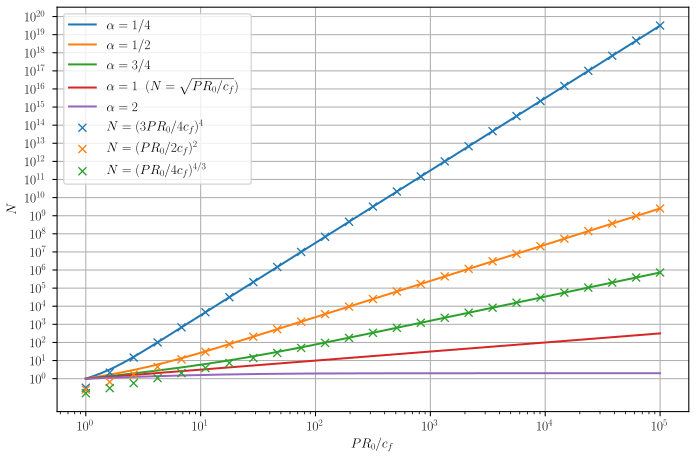 Number of nodes $N$ versus $P R_0/c_f$, on a log scale. The
straight lines were
solved for numerically, and corresponding approximations were overlaid with
markers, except for $\alpha=1$ and $2$.
Number of nodes $N$ versus $P R_0/c_f$, on a log scale. The
straight lines were
solved for numerically, and corresponding approximations were overlaid with
markers, except for $\alpha=1$ and $2$.For $0 <\alpha \ll 1$, a $C$x change in underlying factors will result in $C^{1/\alpha}$x change in network size. For $\alpha=1$, the change will be $\sqrt{C}$x.
Let $\alpha=1$. Then a $2$x increase in price or rewards will result in a $\sqrt{2}$x increase in network size. Conversely, a $2$x increase in fixed costs will result in $\sqrt{2}$x decrease in network size. If we let $\alpha = 1/2$, a $2$x change to the factors result in $4$x change in network size, and so on.
References
-
Buterin V., Discouragement Attacks, 16.12.2018. ↩
-
Thum M., The Economic Cost of Bitcoin Mining, 2018. ↩